
What do you think of when someone says “educational game”? Do you wonder about its platform, its OS, if it’s a mobile app or console game? Or, do you consider analog games such as chess, Monopoly, or Dungeons & Dragons to also have educational possibilities?
Have you ever thought of using live action role-playing or larp, as a learning tool?
I founded Seekers Unlimited, a Los Angeles-based public charity that designs educational larps – edu-larps – for the classroom. We have run four programs with four different schools. The results have been strikingly positive. Preliminary data from a recent study revealed that 100% of students who experienced an edu-larp said they would like to learn using larp in the future.

Students playing one of Seekers Unlimited’s edu-larps
What is an edu-larp?
Larp is an acronym for Live Action Role-Playing. The term is modern, dating back to America and the United Kingdom in the late 1970’s and early 80’s. The technique, however, is ancient and global. Any time two or more people take on roles and interact in real space to communally create a narrative for themselves instead of a passive audience, they are larping. Larps have also been called interactive theater, participatory drama, live games, and live role-playing.
This near-magical process of total physical, intellectual, and emotional engagement is oft utilized for high-intensity entertainment, but can – and should – be used as a remarkable tool for education.
How is edu-larp implemented into the classroom?
Although many teachers in the U.S. occasionally implement a larp activity into their curriculum – a Roman Senate or Civil War scenario – Seekers Unlimited is, so far, the only known formalized company that brings live action role playing adventures directly to American classrooms. After-school and summer camp edu-larps exist such as Renaissance Adventures, Pretend City, and, internationally, KidZania. There are two notable edu-larp exceptions outside the U.S.: Østerskov Efterskole, an all-larp based boarding school in Denmark, and LajvVerkstaden, a Swedish company that also makes educational larps inside and outside the classroom.

A student playing the Star Seekers edu-larp
Usually, Seekers Unlimited begins an edu-larp program by consulting with the teacher, gathering data about the class, subject, and available resources. Our designers create one or multiple scenarios of varying duration that integrate the assigned subject matter into an interactive narrative. The teacher runs the scenario; our staff attends class merely to observe and answer design questions.
Once a scenario has been playtested we process the feedback and observations from our staff, the students themselves, and the teacher. We correct mistakes and improve assets in a system we call “boxing.” Once the edu-larp is boxed we release it to the public where any school can purchase a perpetual license to run it.
A sample of the scenarios we have run so far:
- In Star Seekers a sixth-grade classroom was transformed into a spaceship, with the students as crew. They were assigned a mission to complete. Each section of the ship: Bridge, Engineering, Observation and Stardusters had a different set of tasks to complete to keep the ship operating, e.g., the engineering section needed to complete fraction problems to generate power to the engines, shields, etc.
- In Hit Seekers students role-played music company executives competing to make the most money by signing fictional artists, producers, and recording studios to create albums. This required reading comprehension, accounting level math, budgeting, and some geometry.
- The Great Phlogiston Debate mixes the history of the Age of Enlightenment with the scientific theories that arose in that time period. Students role-play real historical figures from the late 18th century at a French garden party where they debate scientific hypothesis and run experiments.
- Noir, where students take on the roles of police detectives, forensic scientists, or witnesses/suspects and use science to unravel a mysterious death, began from a suggestion by a student who was a Raymond Chandler reader.
Why does edu-larp work?
This author’s growing experience with educational live action role playing has revealed:
- Students become intrinsically motivated to learn – not to get a grade or because the teacher assigned them work, but because they want to improve their character or complete the narrative adventure.
- When an issue arises in the adventure and is solved in that same adventure – what is called “emergent gameplay”- student attention and personal investment is very high.
- Related to emergent gameplay, when students are empowered to alter the rules of the edu-larp, their involvement increases. In our edu-arp about Ancient Mesopotamia (available for free here), one student researched his role as a priest and presented a case to the teachers as to why priests should have a higher income. The teachers agreed and the priests’ income rose—this took about five minutes. How long would it take an educational video game to change its program based on the research of a student?
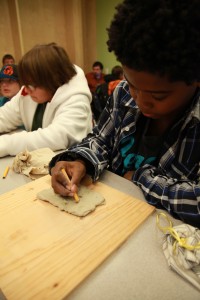
Children in the Mesopotamia edu-larp writing on clay

- Student learning can often be on a deep conceptual level. Not just cognitive, but affective (the emotional aspect), and even, to some degree, the psychomotor realm. One part of the Mesopotamia scenario asked students to design cuneiform symbols for different trade goods. They were given real clay and styluses (pencils) to work with. When confronted with the arduous task of drawing a fish, one girl said “We don’t have to make it look like a fish, we just have to all agree that what we draw means fish.” Would that have occurred if they didn’t get their hands muddy?
- Instructor involvement is on the same narrative level as the students. The improvisational nature of larp means that teachers can also be surprised by the adventure as much as the students.
- Edu-larps integrate multiple subjects easily: history, science, math, language, etc. into a holistic education. They also include creative writing, art, physical education and 21st Century Skills.
- Edu-larps are contextual, not abstract. Knowledge attached to emotional baggage has a greater chance of retention; it’s easier to recall the quadratic formula when it’s used to save the ship from plunging into a black hole rather than using it to blacken a Scantron bubble.
- Cooperation and peer-to-peer learning is key to most edu-larps. This provides flexibility to different learning levels: those who are behind can get assistance from those who aren’t.
- Character failure is acceptable in an edu-larp. Students are free to experiment as well as experience the consequences of their choices.
- Seekers Unlimited believes that we don’t know any class as well as the instructor. We use the model of role-playing games for our edu-larps: we are the scenario designers, but it is up to the Game Master (GM) to personalize it for their players, a.k.a. students.
Issues with Edu-Larps
The following elements are hindering the growth and progress of educational larps.
- Teachers need professional development. Not all instructors are familiar with role-playing, and may be hesitant to use it. We are working on a PD program for teachers as well as creating a network to allow practitioners of edu-larp to communicate with another.
- Little research has been performed on the efficacy of video games, and even less on edu-larp. More studies must be conducted in controlled conditions to verify any benefits. All the points above are anecdotal, not part of controlled research.
- A practical system for assessment must be created and integrated into all edu-larps. There are methods of grading students in edu-larps such as final papers, presentations and interactions with instructors, but these must be quantifiable.
- An issue with educational video games is transfer, or the ability of the student to truly know the material outside of the original medium of instruction. If they get a high score on a math game, can they also apply that ability to pencil and paper mathematics? Our hypothesis is that edu-larp’s transfer rate is better than that of video games, but both must be tested before anything is proven beyond speculation.
- Edu-larps aren’t as shiny as video games. They don’t have colorful cute sprites dancing around a high-def screen with cheery music and pixelated smiles. They require interaction and support not just from the teacher, but the students themselves. Improving education around the world doesn’t require expensive CPUs. We just need a little imagination.
Aaron Vanek is the founder and Executive Director of Seekers Unlimited, located in Los Angeles. For more information, go to their website: http://seekersunlimited.com/
[…] Edu-larps: live action role-playing in the classroom, an article on edugameshub […]