
Playing what was in effect a giant game was inappropriate in an academic environment” – (student quote)
I work in Higher Education: my day job is a course designer (designing new degree courses, essentially) and teaching digital humanities. But my research interest, and most interesting work, is in the design, use and study of games for adult learning. And I’ve certainly come across comments like the opening one in my work. In the following snippets, I aim to summarise some of the problems and benefits that I, and colleagues in the field, encounter when mixing games and adult learning.
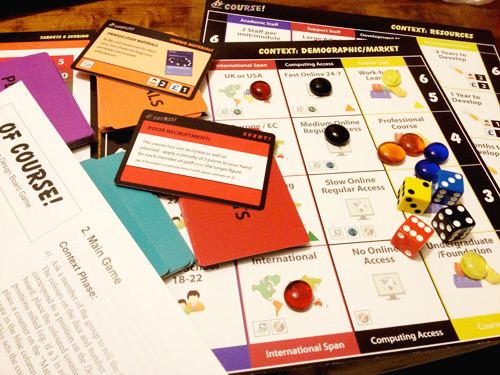
The Of Course! board game, used to teach course design concepts
Games for adult learners? What’s different?
Game design principles are core to a good game no matter which context, so in some senses games for learning with adults follow the same design and development cycle as any other. The difference is one of attitude – in any group of 18+ adults, some might actively play games; some might actively hate games; many others will think of them as unrelated to their learning experience (particularly a £9k-a-year learning experience). As with any learning or teaching experience, games must feel worthwhile and relevant to the learner. Whilst non-related, poorly chosen games for younger learners might be accepted more readily or with a groan, poor choices like this for learners in HE might lead to formal complaints from the students themselves or their parents.
Are they serious enough for HE?
The other problematic side of games in an HE context is that of the formal curriculum. Universities have strict codes of practice around how a programme is taught and assessed, and this has been ingrained further with the current publication of the QAA’s new Quality Code. Games or games-based approaches need to fit into these codes, and be described in the same language as other teaching and learning activity. Unless you are a head of faculty, this means any games-based approaches need to persuade local teaching teams/departments, as well as the institution itself, of their merit. Starting with a solid set of learning outcomes, for example, is a good beginning to this process; but careful thought to how learning is assessed (whether in-game, post-game and formative or summative) is vital too, and usually the most difficult part.
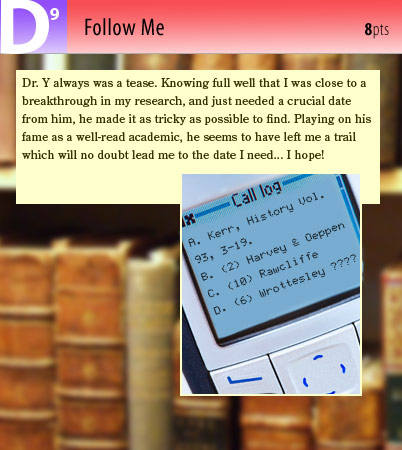
A puzzle from the Great History Conundrum
For my own games-based approaches, I’ve found that involving the wider department in aspects of the design is invaluable: basing challenges or puzzles around their own subjects, for example. I also tend to introduce a game as a pilot, and then with a small percentage of overall assessment weighting (10% of the course) in the first full year; rising as good feedback is received from students (my Great History Conundrum now provides 50% of the assessment on the course). Oh, and the student who delivered the damning line at the start of the module? They went on to say: “[I was able to] work as a team and get to know more people; the puzzles made me think and enabled me to learn vital skills for the next three years”.
Off-the-shelf, buy-in or build-yourself?
There are some great examples of lecturers who have used off-the-shelf game titles to teach particular concepts, or encourage group work or skill development. Minecraft, for example, has been used to teach programming concepts; Spore was issued to students as a private study aid to inform discussion in first year tutorials; and commercial war games were used by a History lecturer to help students model and discuss battle tactics. That doesn’t always work out, of course, and licensing or distribution amongst large groups can mean there is a financial cost.
Where budget isn’t an issue, custom-designed (or adapted) digital games are a possibility, and this is where the serious games movement has staked a hold. There are some fascinating examples of simulation-based games (particularly in healthcare and management education) but also many cases where the education side dominated at the expense of gameplay (the ‘chocolate coated broccoli’ syndrome).
Where there is no, or little, budget (ie. the majority of the time in the current climate) lecturers or trainers have turned to low cost, traditional methods: and this is the area which has interested me most in recent years. Some have a basic game design background (eg. ex designers or researchers in the field) but many just call on their own experiences or interests in games, and have produced some very interesting examples. Along with my colleague Nic Whitton (Manchester Metropolitan University) we gathered examples of such activity from around the world in our recent book, and uncovered some very clever games based approaches to complex learning aims: a board game using the idea of randomness to teach Genetics, for example; or a set of simple geometric shapes representing fountains and horses which teaches cultural awareness through some fast-paced, cut-throat gameplay.
Make things authentic

The Viola Quest ARG (the ARGOSI project)
Another interesting cross-over into education is that of alternate reality, pervasive and immersive game genres. ARGs have been used with much the same impact as in pure game form (a relatively small subset of very highly engaged players, with a larger group of low-engaged followers – ARGOSI one of the more interesting examples). More recent work includes a pervasive game approach to professional skills teaching: the Pervasive Learning Activity (Brookes & Moseley, 2012).
That big word: motivation
The most often quoted benefit of games for education is that they are ‘motivating’. Whilst it’s true that there are certainly examples where the use of games has increased engagement with an activity or subject, this universal truth can’t be assumed in every situation and for every student. Competition might be motivating for some, but to their friends it might be a sure fire demotivator. As with good learning design, a range of approaches within good game design is more likely to generate wide engagement, by providing something of interest to all students.
That second big word: gamification

The Never Ending Uni Quiz, University of Brighton
Education can’t fail to be touched by this bandwagon sweeping the commercial world. Many of the big online learning platforms are rolling out badges and points in their upcoming releases. But as we all know, these elements alone do not a game (or fun) make. That said, there have been some very interesting examples where particular game elements have proved successful: Katie Piatt’s Never Ending Uni Quiz at the University of Brighton, for example, sees student houses battle against each other on a simple ‘university facts’ platform; and Andy Walsh’s Lemon Tree activity for Huddersfield University Library encourages wider reading and sharing of resources amongst students for campus rewards. There’s much still to explore in this area going forward.
Find some friends to help
Although sometimes you might have the luxury of a budget, and games development expertise (either designers or digital developers), your first forays into games in the curriculum will usually find you on your own with almost no money to spend. This is where a friend or two who have been through the process already, and can offer assistance or encouragement, are invaluable. You might find others in your subject area, or faculty, who can work with you – and of course there’s this great blog. But there’s also the Games and Learning Special Interest Group (GLSIG), chaired by myself and Nic Whitton, which currently has around 80 members all of whom research, develop, use or want to use games in HE. There are always friendly faces around to help with design, playtest ideas, or join together to look for funding or research opportunities.
Comments are closed.