
Edugameshub enjoyed lunch in Shoreditch with Bernhard Niesner of Busuu – the language learning platform that’s injected a much needed dose of social into language learning.
What’s in a name?
Busuu (pronounced boo-zoo) is a language spoken in Cameroon, but only by 8 people! The team at Busuu created this video to share information about this endangered language, and to encourage more people to learn it.
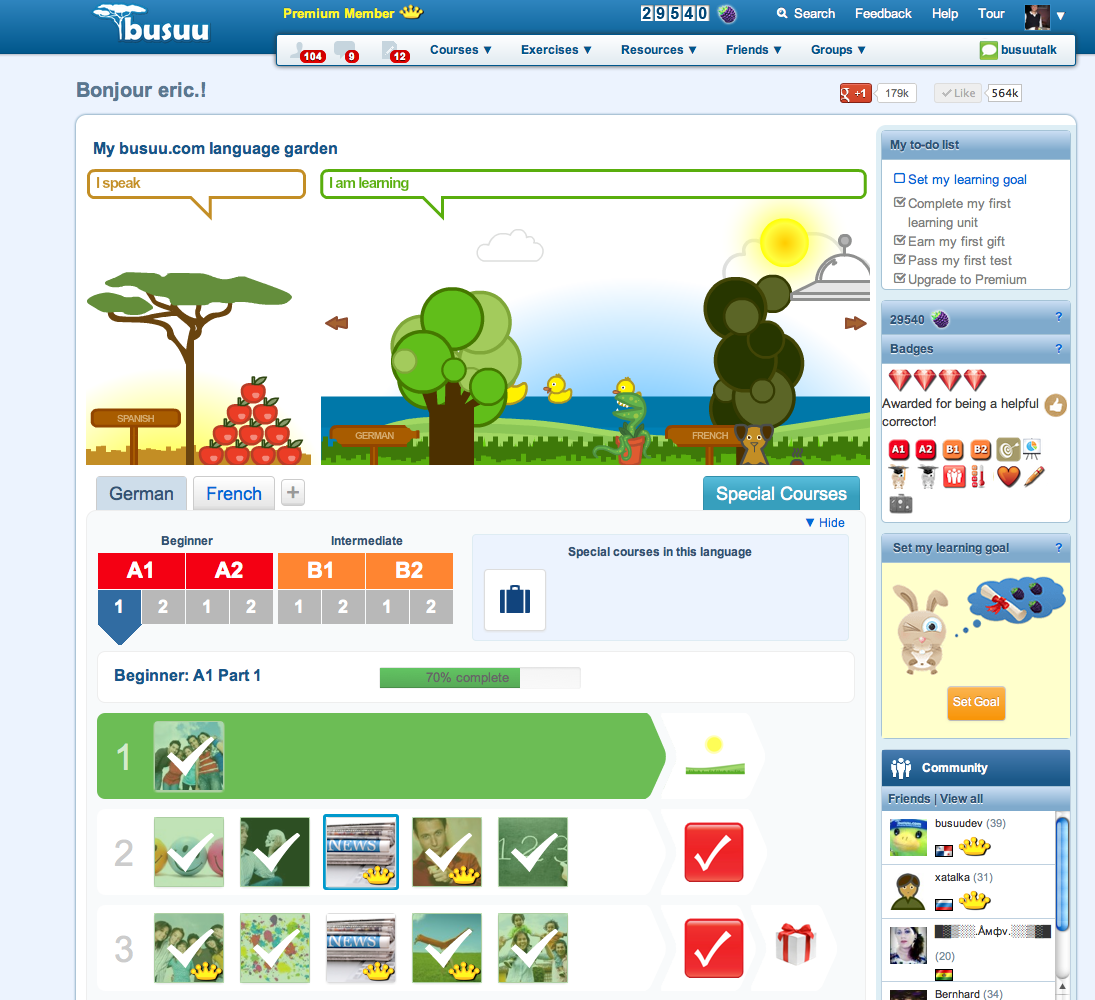
Busuu’s website
History
Over some very tasty beetroot soup and smoked mackerel, Bernhard took us through the history of Busuu. He and his co-founder, Adrian, met at business school in Madrid. Whilst kicking around various business ideas they realised they had both struggled to learn a variety of different languages (Bernhard speaks German, English and Spanish and Adrian speaks German, English, French and Schweizerdeutsch). At the time, Facebook was gaining popularity, and the two fledgling entrepreneurs hit on the idea of launching a language learning site which combined elements of social media and social networking.
Based in Madrid, Busuu was launched in 2008, with content for learning four languages: Spanish, French, English and German. For the first two years, the team bootstrapped their startup. They began generating a small amount of revenue after the first year. Then, in the second year they received some funding from an Austrian business angel, enabling them to finance some online marketing and add more languages.

Busuu co-founder, Bernhard Niesner
Since then, Busuu has grown and grown, to the point where it now represents serious competition for established language learning platforms like Englishtown and Global English, as well as more traditional systems like Berlitz or packaged software like Rosetta Stone (which is probably what prompted Rosetta Stone to buy Busuu competitor, Livemocha).
A year ago the Busuu team made the tough decision to move their HQ from Madrid to London, partly because of the economic difficulties in Spain but also because the difficulty in finding the right staff.
Busuu now features 12 languages and a community of 35 million users. 40,000 new users join the site each day and Bernhard predicts continued growth, especially in mobile, with Brazil, Russia and Latin America representing some of their largest growth markets.

A screenshot of the Busuu iPad app
So what’s the USP?
Busuu has a very strong emphasis on social and community (when you join Busuu you can quickly chat with other members of the community in the languages you specify). Unlike Englishtown and Global English, Busuu offers 12 languages, rather than just one. This means you can practice a variety of languages and skill swap (for example, you are prompted to correct short pieces of written work from other community members, who will then do the same for you).
Gamification also plays a part in the Busuu experience. The more you do around the site, and the more you interact with other community members, the more ‘Busuu berries’ you earn (we experimented with this, and found it strangely addictive). In some ways the Busuu interface is much more like being on a social networking site. It won’t be long before you hear a whistling sound and see a chat pane with someone from the Busuu community requesting to practice speaking with you – it’s about as different from secondary school French class as you could imagine (or hope for).
Challenges
Along with many other entrepreneurs, Bernhard lists Busuu’s greatest challenge as finding the right team. The move to London has helped, but brought about its own additional challenges as 10 people made the move from Spain to England and rebuilt their lives and their business almost from scratch. The Busuu office today is a slick and surprisingly calm space near Old Street in Tech City, and is home to 30 staff. Bernhard is delighted with the move and with the choice of London as a hub for tech startups, and plans to add another 20 people to the team in the next year.

The team at Busuu
In addition, the team are constantly working on improving the site. A content overhaul this summer aims to improve the efficiency of language learning on the site, and they have recently experimented with offering live lessons, making them fully competitive with the more established platforms.
Bernhard concedes there is still a lot to do, particularly in improving reach and encouraging freemium users to activate the premium features, but his enthusiasm and dedication to the task are clear, as is his business acumen.
The future
We finished up with a very interesting discussion about the potential of adaptive learning and the whole quantified self movement. The Busuu team are working on making their language teaching system adaptive to the learner’s individual needs and, if they can pull it off, they will really start to leave the more established paltforms in the dust. Finally, we asked Bernhard if he was worried about the potential of translation software to remove the need for learning another language altogether. In short, he’s not worried: ‘language is so much more than transferring information’.
Comments are closed.